
Your driveway is the first thing guests see — and the last thing you want to worry about. Let us build it right so you never have to think about it again. Licensed & insured, serving San Francisco, Oakland, San Jose, Marin, and the Peninsula since 2001.
SDW Construction (also known as S.D. White Construction and operating as Bay Area Concrete) has been installing and repairing concrete driveways across the San Francisco Bay Area since 2001. That’s over two decades of local projects — from single-car driveways in San Francisco’s Sunset District to sweeping estate driveways in Marin and stamped concrete upgrades across Walnut Creek and Danville.
We’re a local contractor, not a franchise. We understand Bay Area soil conditions, city permit requirements, and the drainage challenges that come with sloped lots and clay-heavy ground. Whether you need a brand-new driveway, a full demo and replacement, a decorative stamped finish, or a repair that actually holds — we build it right the first time and stand behind every job we complete.
No matter the challenge — difficult soil, steep slopes, tight San Francisco lots, or complex decorative finishes — we build what works and we stand behind every job we complete. Request your free onsite estimate today →
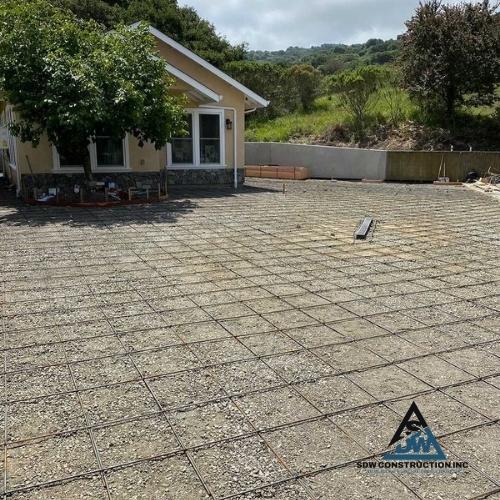
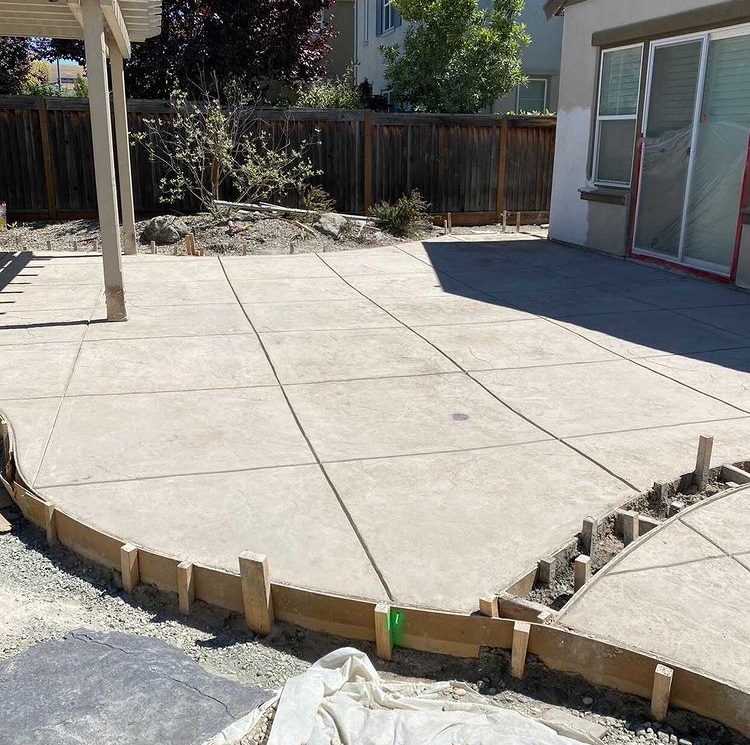
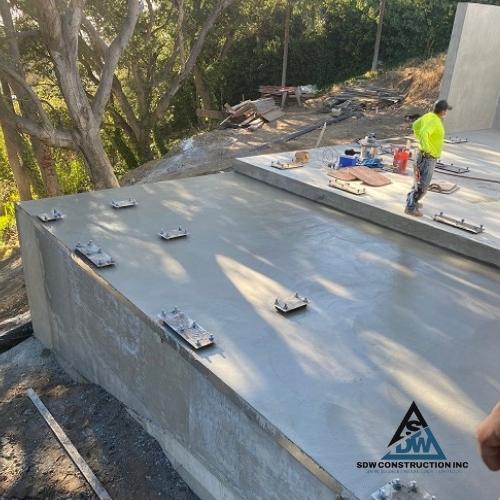
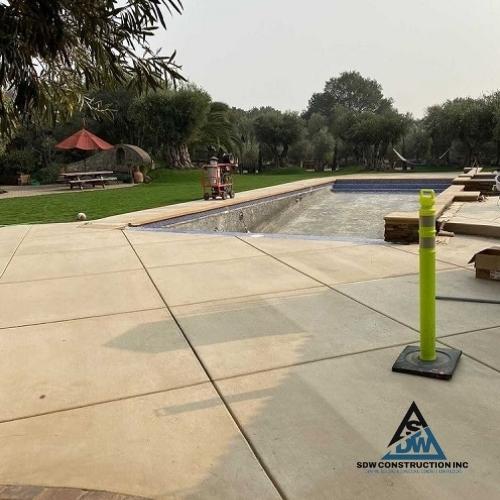
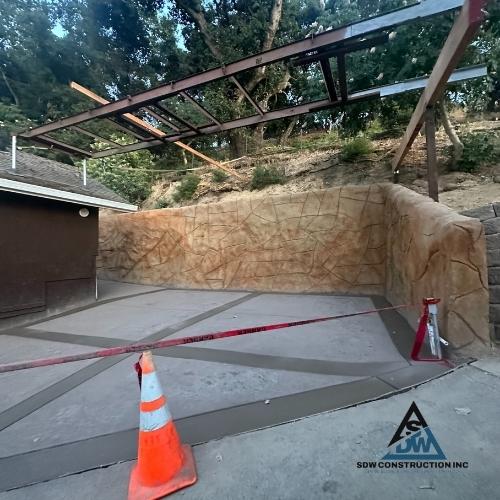
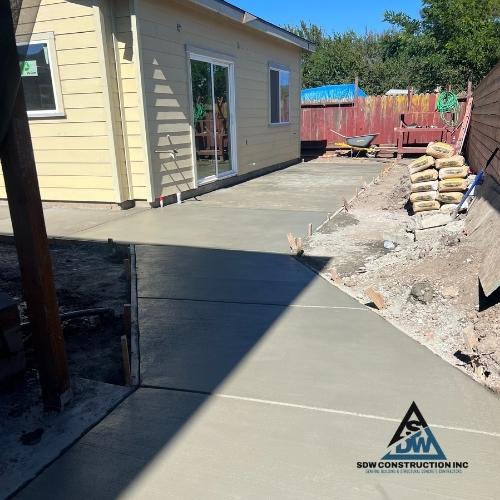
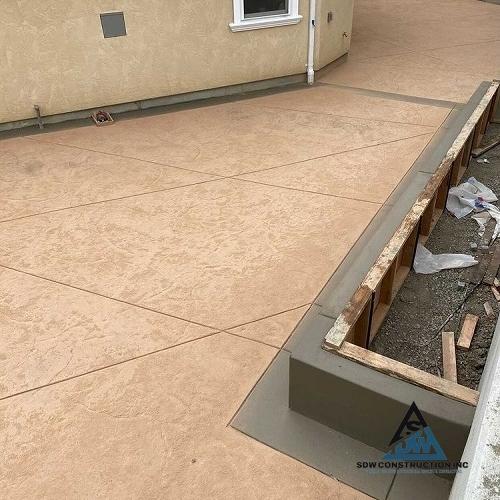
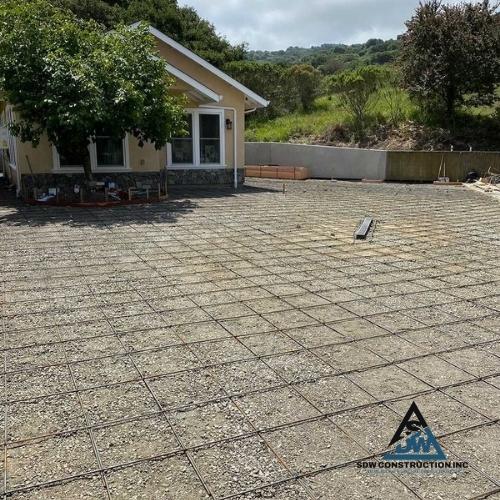
We cover the full range of residential and commercial concrete driveway work across the Bay Area — from new builds to repairs, standard finishes to premium decorative work.
A lot of contractors rush the prep work. That’s why driveways crack within a few years. Here’s exactly how we build every driveway — step by step — and why each stage matters.
Day 1 — Pre-Construction
We measure the area, evaluate soil and drainage, discuss design options, and confirm permit requirements with your city (SF DBI, Oakland, San Jose, Marin, etc.). We also check for underground utilities before anything starts.
Day 1–2 — Excavation
We excavate to the correct depth — typically 6–8 inches total — allowing for 4 inches of compacted aggregate base plus a 4-inch slab minimum. Bay Area clay soils need special attention here. Poor subgrade is the number one cause of driveway failure.
Day 2 — Base
We lay Class II aggregate base and compact it in lifts to approximately 95% relative compaction. This creates a stable platform that won't shift or settle. It's invisible once the job is done — but it's everything.
Day 2–3 — Formwork
We set forms to define the driveway shape and establish proper slope — a minimum 1–2% grade away from the structure is critical for drainage. Bay Area lots are often sloped, so we plan drainage carefully to avoid runoff toward foundations.
Day 3 — Reinforcement
For residential driveways we typically use #3 or #4 rebar on 18-inch centers. In seismically active Bay Area, we prefer rebar over wire mesh for superior crack control. Reinforcement sits on chairs to maintain 2 inches of concrete cover from the bottom.
Pour Day + 24 hrs
Control joints are cut to 1/4 of the slab depth to direct where cracking naturally occurs. We wet-cure or apply curing compound for a minimum of 7 days. Concrete reaches full design strength at 28 days — don't drive on it for at least 7.
Pour Day
We order a ready-mix concrete — typically 4,000 PSI with a 4–5 inch slump. The crew screeds, bull-floats, and hand-finishes before the concrete sets. Decorative finishes like stamping or exposed aggregate are applied at this stage.
Day 28 — Completion
Once fully cured, we apply the appropriate sealer for your finish type. We then do a final walkthrough with you to confirm everything meets expectations — and document the project with photos.
Bay Area concrete driveway projects vary widely based on your specific site, design goals, and scope of work. Rather than publish a price list that doesn’t reflect real project complexity, we prefer to assess your property in person and give you an honest, itemized quote you can trust.
Factors that influence your project investment include:
Every project gets a free, no-obligation onsite estimate. We walk your property, measure, assess, and give you a clear written quote — so you know exactly what you’re investing in before any work begins.
| Material | Lifespan | Maintenance | Best For |
|---|---|---|---|
| Concrete | 30–40 years | Low — seal every 3–5 yrs | Long-term value, versatile look |
| Asphalt | 15–25 years | Medium — seal annually | Lower upfront cost |
| Pavers | 30–50 years | Medium — weeds, resetting | Premium aesthetics, repairability |
| Stamped Concrete | 25–35 years | Low-medium — seal every 2–3 yrs | Paver look at lower cost |
| Gravel | Ongoing refresh | High — raking, replenishing | Rural or informal settings |
Large parts of the East Bay — Berkeley, Oakland, Fremont, Hayward — sit on expansive clay that swells when wet and shrinks when dry. That movement is a primary cause of driveway cracking. Our approach: deeper excavation, thicker compacted aggregate base (sometimes 6 inches or more), and closer control joint spacing to manage movement.
Most of our rain falls in a 4-month window. Driveways need to handle that surge — especially on sloped lots. We design every driveway with drainage in mind: correct cross-slope, channel drains at garage aprons, and coordination with site drainage so water goes where it should, not toward the house.
We live in earthquake country. While a driveway slab is not a structural element like a foundation, seismic movement can cause differential settlement and cracking at joints. We use steel reinforcement on all residential driveways and design slab thickness based on local soil conditions — this is simply good practice for our region.
Properties near the bay or ocean — Richmond, the Sunset District, Pacifica, Marin coast — are exposed to salt-laden air that attacks concrete over time. For coastal locations, we recommend 5,000 PSI concrete mixes and penetrating silane-siloxane sealers that protect against chloride penetration without changing surface appearance.
In most Bay Area cities, replacing an existing driveway in the same footprint may not require a building permit — but adding a new driveway, widening an existing one, or modifying a curb cut almost always does. Requirements vary by city. Always verify with your local building department:
We advise on what we’ve seen in practice, but always confirm current requirements directly with your city — they change. If your property has an HOA, check your CC&Rs before finalizing any design or color choices.
A quality concrete driveway, properly maintained, should last 30 years or more. The upkeep is simple — it just needs to happen on schedule.
Seal a new driveway no sooner than 28–30 days after the pour. After that: every 3–5 years for plain concrete, every 2–3 years for stamped or colored finishes. Penetrating sealers repel water without changing the appearance; film-forming sealers add a sheen and are popular on stamped work.
Before November, inspect your driveway for hairline cracks and fill them with a flexible polyurethane crack filler before water gets in. Check drainage channels are clear of debris. Water in an unsealed crack will always make it wider — not smaller.
Ready to upgrade your driveway? Tell us about your project and we’ll schedule a free onsite visit — no pressure, no obligation. Serving the Bay Area since 2001.
Over 20 years serving Bay Area homeowners — from San Francisco to San Jose, the East Bay to Marin. Licensed, insured, and backed by a workmanship warranty.
We cover the full range of residential and commercial concrete driveway work across the Bay Area — from new builds to repairs, standard finishes to premium decorative work.

Free onsite visit, site assessment, design consultation, and a detailed written quote. We confirm permit requirements and answer every question before a shovel goes in the ground.

We help you choose the right finish — broom, stamped, exposed aggregate, or colored concrete — and layout to complement your home and work with your drainage and slope.
Our own trained crew handles every step — excavation, base prep, reinforcement, pour, and finishing. We keep you informed throughout and keep the worksite clean and safe.

Final walkthrough with you, project documentation, sealing, and a written workmanship warranty. We don't consider the job done until you're fully satisfied with the result.
Quick answers to questions you may have. Can’t find what you’re looking for? Check out our full documentation.
A properly installed concrete driveway in the Bay Area typically lasts 30–40 years with routine sealing and maintenance.
Bay Area’s mild climate is actually favorable for concrete — no severe freeze-thaw cycles. Key factors are subgrade preparation, mix strength, reinforcement, control joints, and sealing every 3–5 years.
Bay Area driveway costs vary depending on size, site conditions, finish type, slope, permit requirements, and demolition needs. Because every lot and project is different, we don’t publish a standard price list — instead, we offer a free onsite estimate so you get an accurate number for your exact project. Contact us to schedule yours.
Physical installation takes 2–4 days, but you cannot drive on the slab for at least 7 days after the pour. Permitting can add 2–8 weeks in Bay Area cities.
Full concrete curing takes 28 days. The slab is usable for passenger vehicles after 7 days. Wait 30 days before applying sealer.
Yes — cracks under 1/4 inch wide, minor spalling, and surface staining can often be repaired rather than replaced, saving significant cost.
Replacement is needed when slabs have shifted significantly, structural cracks are extensive, or the subgrade has failed. We assess every driveway honestly — if repair is the right call, we’ll say so.
Yes — stamped concrete delivers a premium look at a fraction of natural stone or paver pricing, and it’s a very popular choice throughout the Bay Area.
It requires resealing every 2–3 years and should include an anti-slip additive in the sealer — which we apply as standard. Popular patterns include Ashlar slate (great with craftsman homes) and cobblestone (great for Spanish/Mediterranean styles).
Wait at least 7 days for passenger vehicles. Avoid heavy trucks for 28 days.
Concrete reaches approximately 70% of design strength at 7 days and full strength at 28 days. Driving on it too early causes surface damage — tire marks and cracking — that’s hard to fix.
Exposed aggregate concrete reveals decorative stone at the surface — naturally textured, slip-resistant, and visually attractive. Excellent for sloped Bay Area driveways.
One of our most-requested finishes. The texture provides natural grip when wet, and the look ages beautifully — it actually looks better at 15 years than it does brand new.

We are a licensed and insured Bay Area concrete contractor providing all types of concrete construction for both commercial and residential clients. Operating as SDW Construction / S.D. White Construction, serving the Bay Area since 2001.
630 Second St rodeo CA 94572
Mon–Fri: 7:30AM – 5:30PM
Saturday: Closed
Sunday: Closed
Proudly serving the entire San Francisco Bay Area — San Francisco, Oakland, San Jose, Marin County, the Peninsula, and surrounding cities.
© 2025 SDW Construction / S.D. White Construction. All Rights Reserved.