From hillside retaining walls in Marin and Oakland to pool shells in San Jose and structural shotcrete walls across the Peninsula — SDW Construction has the crew, the pump, and 20+ years of Bay Area experience to get it done right.
Shotcrete is one of the most powerful tools in concrete construction — and in the San Francisco Bay Area, it’s practically a necessity. Our region’s steep hillside lots, expansive soils, seismic risks, and tight construction access make sprayed concrete the right method for dozens of projects that poured concrete simply can’t handle.
SDW Construction (operating as S.D. White Construction) has been providing shotcrete services across the Bay Area since 2001. We own our own B50 Reed shotcrete pump — a unit capable of delivering 50 yards per hour through several hundred feet of hose, reaching the tight corners and steep hillside sites that define Bay Area construction. Our crew are experienced shotcrete applicators, not general laborers assigned to the pump truck on pour day.
Need a shotcrete retaining wall, pool shell, slope stabilization, or structural wall in the Bay Area? Request a free onsite estimate → or call us at (510) 426-1854. Ask about our license, insurance, and workmanship warranty.
Shotcrete is versatile enough to build or stabilize structures that would be impractical with traditional formwork. Here’s what we work on most in the Bay Area.
Shotcrete is concrete or mortar that’s pneumatically projected — sprayed at high velocity — through a hose and nozzle directly onto a surface. The high-velocity impact compacts the material as it’s applied, creating a dense, strong structure with excellent adhesion to rock, soil, steel, and existing concrete. Because the concrete goes where the hose goes, you can build or coat vertical walls, curved surfaces, steep slopes, and hard-to-reach areas without the full wood or steel formwork that poured concrete requires.
For Bay Area construction specifically, this matters enormously. Most of Marin County, the Oakland and Berkeley Hills, San Francisco’s western neighborhoods, and large parts of the Peninsula and East Bay hills involve steep terrain, retaining requirements, and tight site access that make traditional formwork either impractical or impossibly expensive. Shotcrete turns what would be a major logistical problem into a manageable scope of work.
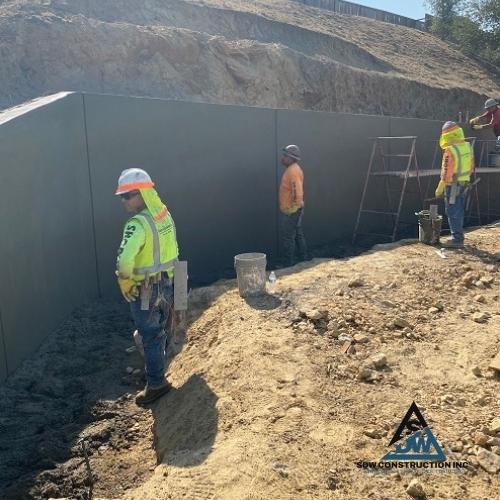
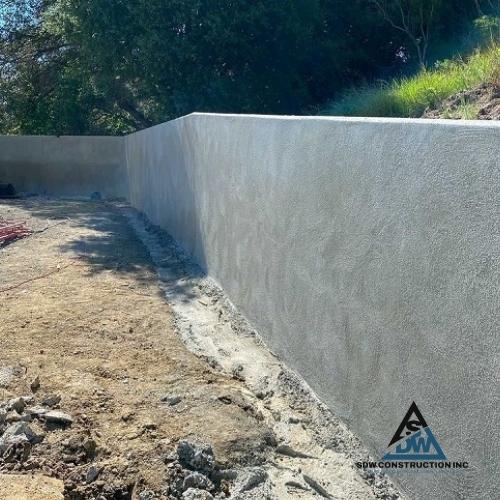
Shotcrete retaining walls are one of the most practical solutions for Bay Area hillside properties. We place a reinforced steel cage or rebar mat, spray shotcrete to the engineered thickness — typically 6–12 inches for structural walls — and finish the surface as specified. Shotcrete walls can be built against cut slopes, tiered for steep lots, or constructed freestanding with drainage integrated from the start.
Most Common Bay Area Use
The Bay Area's hillside terrain — Oakland Hills, Marin, the Peninsula foothills, and parts of San Francisco — sees slope movement every rainy season. Shotcrete slope facing, combined with soil nails or rock anchors, stabilizes eroding or unstable slopes permanently. We spray a reinforced shotcrete blanket over the slope face to lock in surface material and prevent further erosion, often in coordination with a geotechnical engineer.
Critical for Hillside Properties
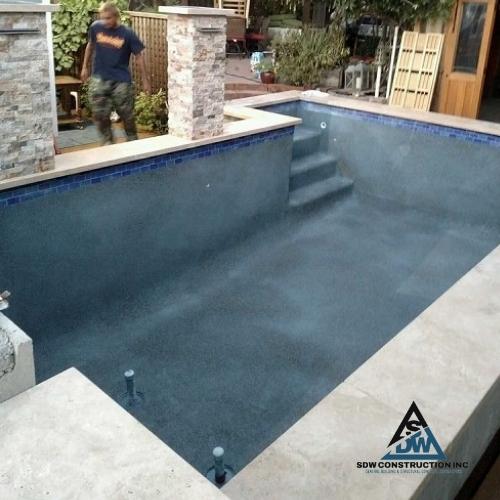
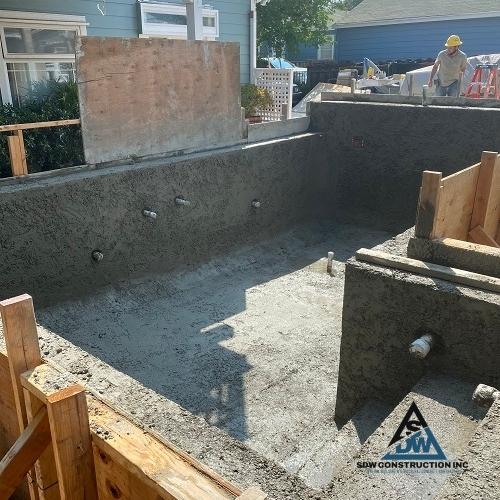
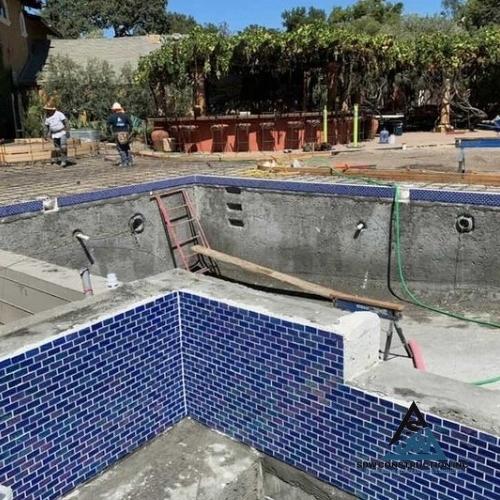
Shotcrete and gunite are the standard construction methods for in-ground swimming pools — and for good reason. The spray application creates a pool shell that conforms to any shape, accommodates any depth, and reaches consistent thickness even on vertical walls and tight curves. Bay Area pools often require elevated seismic reinforcement. We install the steel, spray the shell, and hand it off ready for plaster, tile, and coping.
High Demand — Bay Area
Architectural and structural concrete walls for new buildings, commercial projects, and residential additions can be built using shotcrete where traditional forming would be impractical. Shotcrete vertical walls achieve the same structural performance as cast-in-place concrete when properly reinforced and applied — and are faster to build on tight sites. Common in below-grade construction, below-street parking walls, and hillside building retaining systems.
Commercial & Residential
Soil nail walls pair drilled steel tendons into the hillside with a shotcrete facing panel to create a stable retained system that's especially effective on steep Bay Area hillsides. The tendons are drilled at angles into the slope, then tied into a rebar mat and covered with a 4–8-inch shotcrete face. This system is widely used for cut slopes in construction, landslide stabilization, and roadway support across the Bay Area.
Advanced — Engineer-Designed
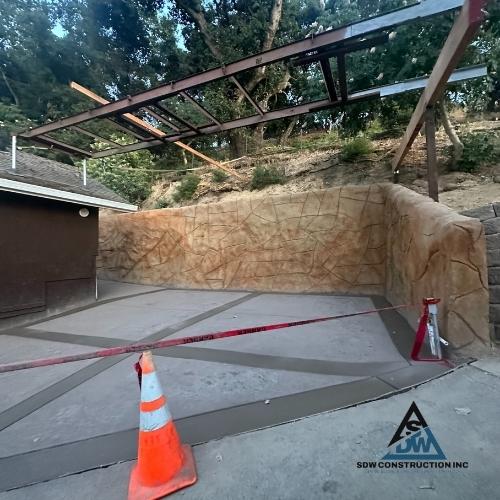
Beyond structural work, shotcrete's shape-forming ability makes it ideal for sculpted features — natural rock formations, wine cave linings, waterfall structures, and custom architectural wall features. In the Bay Area wine country adjacent communities (Napa access from the East Bay, Sonoma from Marin) and high-end residential properties across the Peninsula and Marin, these decorative applications are increasingly popular.
Custom & High-End
Pre-Shoot
The substrate — whether it's a cut slope, existing concrete, soil, or steel formwork — must be prepared before any shotcrete is placed. For slope facing, loose material is cleared and the slope is graded to a stable angle. For retaining walls, the cut face is trimmed and drainage systems are planned. For pool shells, excavation is completed to the engineer's dimensions. A poorly prepared surface is the leading cause of shotcrete delamination and failure.
Pre-Shoot
For structural retaining walls and pool shells, a steel reinforcement mat or cage is placed before any concrete is sprayed. For retaining walls, this is typically #4 or #5 rebar on 12-inch centers both ways. Reinforcement must be tied and positioned so the shotcrete can fully encapsulate it — a minimum of 2–3 inches of cover behind and in front of the steel. In Bay Area Seismic Design Category D, rebar sizing and placement in shotcrete retaining walls often exceeds what a non-seismic project would require.
Pre-Shoot
Every shotcrete retaining wall in the Bay Area needs a drainage system behind it. Hydrostatic pressure from our wet season rainfall is the number-one cause of retaining wall failure — concrete, shotcrete, or otherwise. We install perforated drain pipe wrapped in filter fabric at the base of the wall backfill, with weep holes or outlet pipes through the wall face at regular intervals. Ignoring drainage is a shortcut that produces walls that lean, crack, and eventually fail.
Application
We use our B50 Reed concrete pump, which delivers up to 50 cubic yards per hour through several hundred feet of hose. This reach capability is critical for Bay Area hillside sites where the pump truck can't get close to the wall face. For structural applications, we specify 4,000–5,000 PSI concrete mix. Coastal Bay Area sites may warrant admixtures for sulfate and chloride resistance. Mix design is confirmed before the shoot begins.
Application
The nozzleman applies shotcrete in layers, building up to the specified thickness (typically 6–12 inches for structural retaining walls, 6–9 inches for pool shells, and 4–6 inches for slope facing). The nozzle is held perpendicular to the surface at the correct standoff distance — around 3–5 feet — to maximize compaction and minimize rebound. The steel reinforcement must be fully encapsulated with no voids or shadowing behind the bars. A skilled nozzleman can see and hear the difference between good encapsulation and a shadow void — an inexperienced one cannot.
Finishing
Once the shotcrete is applied to full thickness, the surface is finished as specified — rod-cut to a flat plane for retaining walls, hand-formed for pool shells and curved features, or left natural-texture for slope facing. Curing begins immediately after finishing — we apply a chemical curing compound or keep the surface moist for a minimum of 7 days. Bay Area summer conditions (heat and fog cycles) require careful curing management to prevent surface cracking.
Post-Shoot
Structural shotcrete walls typically require a special inspection during application and core samples or test panels for compressive strength verification. We retain batch tickets and, where required, provide test panels to the inspector or engineer. Backfill behind retaining walls is not placed until the shotcrete has reached sufficient strength — typically 7 days minimum — and the drainage system is inspected. Premature backfill loading is a common cause of wall failures we won't contribute to.
| Method | Best For | Seismic Performance | Formwork Needed |
|---|---|---|---|
| Shotcrete Wall | Hillsides, complex shapes, tight access | Excellent with rebar | Minimal or none |
| Poured Concrete Wall | Straight walls, easy access sites | Excellent | Full forms required |
| CMU Block Wall | Moderate height, accessible sites | Good (grouted & rebar) | No |
| Soil Nail + Shotcrete | Steep cuts, existing slope retention | Very good | None |
| Segmental Block (Keystone) | Lower walls, landscaping, DIY-friendly | Moderate | No |
Most of the Bay Area falls in California Seismic Design Category D — among the highest residential seismic risk classifications in the country. Shotcrete retaining walls in SDC D must meet specific reinforcement requirements. Rebar sizing, spacing, and development length in shotcrete walls are governed by engineer's drawings, not contractor preference. We build to the stamped structural plans, every time.
The Oakland Hills, Berkeley Hills, Marin hillsides, San Francisco's western neighborhoods, and Peninsula foothills all involve steep lots where cut slopes and retaining requirements are routine. Shotcrete is often the only practical method when a pump truck can't get adjacent to the work face and you need to cover a large area of cut slope quickly. Our 300+ feet of pump hose reaches where other contractors can't.
Between November and March, the Bay Area receives 80–90% of its annual rainfall. Any retaining wall or slope stabilization system built without proper drainage design will eventually fail under hydrostatic pressure. We design drainage into every shotcrete retaining wall from day one — perforated drain pipe at the base, filter fabric backfill, and weep holes through the wall face. This isn't optional in a Bay Area climate.
East Bay communities — Oakland, Fremont, Hayward, Walnut Creek, and surrounding areas — sit on Montmorillonite clay soils that expand when wet and shrink when dry. This seasonal movement places ongoing lateral pressure on retaining walls. Shotcrete walls in these areas require adequate thickness, proper reinforcement to resist the additional lateral load, and a drainage system that prevents the clay from becoming saturated behind the wall.
Properties near the Bay shoreline, the Pacific coast, or Marin's waterfront face persistent salt air and coastal moisture. For these sites, we specify 4,500–5,000 PSI shotcrete with a blended cement that resists chloride penetration. Standard 4,000 PSI mixes are adequate for inland sites but undersized for coastal Bay Area exposure — a detail that saves you from expensive surface deterioration in 10–15 years.
Many Bay Area residential lots — particularly in San Francisco, the Oakland Hills, and Marin — have no practical way to get a ready-mix truck or formwork materials to the actual wall location. Shotcrete solves this directly: the pump stays at street level or wherever it can park, and our hose delivers material to wherever the work is happening. We've successfully completed retaining walls and slope work that other contractors turned down because of access.
Shotcrete retaining walls, slope stabilization systems, and structural walls in the Bay Area require building permits — and for good reason. These are load-bearing structures in a seismic zone with significant hillside terrain.
Anyone can rent a shotcrete pump. The quality of the work comes down entirely to the crew operating it and the preparation that happened before the first yard was sprayed. We’ve been doing this work across the Bay Area since 2001 — operating as SDW Construction and S.D. White Construction — and we’ve built our reputation on exactly the projects other contractors walk away from: tight hillside access, difficult soil conditions, complex pool geometries, and structural retaining walls that have to perform in a seismic zone.
Ready to upgrade your driveway? Tell us about your project and we’ll schedule a free onsite visit — no pressure, no obligation. Serving the Bay Area since 2001.
20+ years of Bay Area shotcrete experience. Our own pump and crew. Licensed, insured, and built for the sites other contractors won’t touch.
Four clear steps from the first conversation to the finished structure — whether it’s a hillside retaining wall, a pool shell, or a structural shotcrete wall.

Free onsite visit. We assess your slope, wall, or pool site, review any existing engineering drawings, and identify access challenges, drainage needs, and permit requirements upfront.

We give you a detailed written estimate — not a ballpark. It covers shotcrete scope, rebar, drainage, access logistics, and any permit coordination included in our scope.
Our own crew and our own pump. Rebar, surface prep, drainage, and shotcrete application — all handled by the same team. No subcontractors on the shoot itself.

Final walkthrough, inspection sign-offs, batch documentation, and your written workmanship warranty. We don't consider the job done until you're satisfied and the inspector is happy.
Quick answers to questions you may have. Can’t find what you’re looking for? Check out our full documentation.
Shotcrete is used to build retaining walls, swimming pool shells, hillside slope stabilization systems, structural vertical walls, soil nail wall facings, and architectural concrete features — anywhere sprayed concrete’s flexibility and reduced formwork requirements offer an advantage over poured concrete.
In the Bay Area specifically, shotcrete is used heavily for hillside retaining walls (where access prevents traditional formwork), pool shells (the standard method for custom in-ground pools), slope stabilization on eroding hillside properties, and structural walls in new construction on tight urban lots. The method’s ability to reach difficult locations through a pump hose — without needing a truck at the work face — makes it indispensable for Bay Area residential and commercial projects.
Shotcrete refers broadly to any pneumatically applied concrete. Gunite specifically means dry-mix shotcrete, where water is added at the nozzle. Wet-mix shotcrete arrives fully mixed and is pumped to the nozzle where air is added for projection. Both produce strong, durable structures when properly applied.
The key practical differences: wet-mix shotcrete is faster for large structural volumes (retaining walls, foundations, slope facing) and produces more consistent water-cement ratios. Dry-mix gunite is preferred by many pool contractors because the nozzleman controls water addition in real time, which is useful for shaping pool shells and complex curves. For most Bay Area retaining walls and structural work, wet-mix shotcrete is the better choice. For pools and water features, either method works well in skilled hands — dry-mix gunite is most common in the pool industry.
A properly reinforced and applied shotcrete structure in the Bay Area can last 50–100 years with basic maintenance. Retaining walls and pool shells that are well-drained, sealed periodically, and inspected for cracks routinely achieve multi-decade service lives with minimal intervention.
Longevity depends on four things: mix design (PSI, admixtures for the exposure condition), rebar encapsulation (no voids or shadowing), drainage design (water pressure destroys retaining walls from behind), and surface sealing for structures exposed to Bay Area moisture and salt air. The Bay Area’s mild climate (no hard freeze-thaw cycles) is actually favorable for concrete longevity — the main threats locally are hydrostatic pressure behind walls, coastal chloride exposure, and expansive clay soil movement in the East Bay.
Yes — shotcrete (and gunite, its dry-mix variant) is the standard construction method for in-ground swimming pools worldwide. The spray application allows the pool shell to be formed to any shape, size, and depth without extensive formwork. Most custom residential pools in the Bay Area are built using shotcrete or gunite.
For a standard residential pool, the shotcrete shell is typically 6–9 inches thick, reinforced with #3 or #4 rebar on 12-inch centers both ways. The shell is then plastered, tiled, and finished after the shotcrete fully cures. In Bay Area seismic zones, pool shells benefit from heavier reinforcement than in non-seismic markets. The shotcrete scope (shell only) is typically $10,000–$30,000 — the total pool installation including plaster, tile, coping, equipment, and decking runs significantly higher.
The main difference is construction method, not structural performance. Poured concrete walls require forms on both faces of the wall before pouring. Shotcrete walls are sprayed onto one face of a rebar mat without full enclosing forms, making them faster and more practical on hillside sites and tight access locations.
For Bay Area hillside lots where a ready-mix truck can’t park adjacent to the wall face, shotcrete is often the only practical choice. A shotcrete wall achieves the same structural performance as an equivalent poured concrete wall when properly reinforced and applied. Poured concrete may be preferred on accessible flat sites where the formwork isn’t a logistical challenge, since it’s slightly easier to achieve a smooth face finish with forms. For most Bay Area retaining wall applications, shotcrete is the better tool.
Hillside stabilization in the Bay Area typically uses one or more of these methods: shotcrete slope facing (spraying a concrete layer over the slope), soil nailing with shotcrete facing (drilling anchors then shotcreting), retaining walls at the toe of the slope, or engineered drainage systems to remove water that destabilizes the slope. The right method depends on the slope angle, soil type, and how much movement has already occurred.
Most Bay Area hillside stability problems have a water component — seasonal rainfall saturating clay soils or building up hydrostatic pressure. Before committing to a specific method, a geotechnical engineer should assess the slope, identify the failure mechanism, and recommend the appropriate stabilization system. SDW Construction works from engineer’s designs for all hillside stabilization projects — if you don’t have a geotechnical report yet, we can recommend licensed geotech firms in the Bay Area. A stabilization system built without a geotechnical assessment is a guessing game in a seismic zone.

We are a licensed and insured Bay Area concrete contractor providing all types of concrete construction for both commercial and residential clients. Operating as SDW Construction / S.D. White Construction, serving the Bay Area since 2001.
630 Second St rodeo CA 94572
Mon–Fri: 7:30AM – 5:30PM
Saturday: Closed
Sunday: Closed
Proudly serving the entire San Francisco Bay Area — San Francisco, Oakland, San Jose, Marin County, the Peninsula, and surrounding cities.
© 2025 SDW Construction / S.D. White Construction. All Rights Reserved.