
Transform your outdoor space into something you’ll actually use. Licensed & insured, serving San Francisco, Oakland, San Jose, Marin, and the Peninsula since 2001.
Your backyard should be more than an afterthought. A well-designed concrete patio adds usable living space, real property value, and curb appeal that lasts for decades — when it’s built right. SDW Construction (operating as S.D. White Construction) has been designing and installing concrete patios across the San Francisco Bay Area since 2001. That’s over 20 years of local projects — from intimate backyard patios in San Francisco’s Bernal Heights to large entertaining slabs in Los Altos Hills and decorative stamped finishes throughout the East Bay and Marin.
We’re a local crew, not a franchise. We understand Bay Area clay soils, coastal moisture, drainage slopes, and the neighborhood-by-neighborhood permit realities that out-of-area contractors miss entirely. Every patio we build starts with honest advice and a free onsite assessment — no guessing from photos.
Whether you want a clean, functional broom-finish slab or a fully decorative stamped concrete patio with integrated lighting and built-in seating — SDW Construction can build it. Request your free onsite estimate today →
Concrete isn’t just gray anymore. The finish you choose determines how your patio looks, how it performs in Bay Area weather, and how much upkeep it needs. Here are the six main options we install — each with its own benefits and ideal use cases.
The most common and affordable option. A brush dragged across wet concrete creates a lightly textured, slip-resistant surface. Clean and perfectly at home with modern California architecture.
Most Affordable
Rubber stamping mats pressed into freshly poured concrete create patterns mimicking slate, flagstone, brick, or wood plank. Paired with integral color, results rival natural materials at a fraction of the cost.
Most Popular
Surface paste is washed away to expose decorative stone aggregate — river rock, quartz, or recycled glass. Naturally slip-resistant and beautiful. One of the most durable finishes available.
Best Durability
Color is mixed directly into the concrete or applied as a dry-shake hardener. Integral color runs consistent all the way through — chips and scratches don't show white. Earth tones work especially well in Bay Area landscapes.
Great Value
Acid staining reacts chemically with cured concrete to create rich, variegated tones — deep earthy browns, greens, and blues. Each stained patio is unique. Requires sealing and periodic maintenance.
Most Unique Look
Rock salt crystals pressed into fresh concrete then washed away leave a pitted, dimpled texture. Classic for pool decks and coastal Bay Area patios — provides grip without looking rough.
Great for Pool Areas
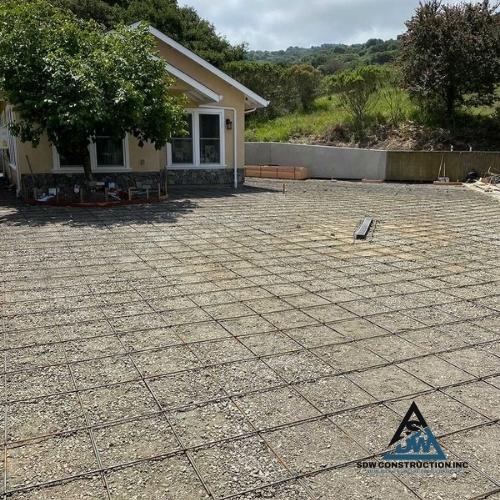
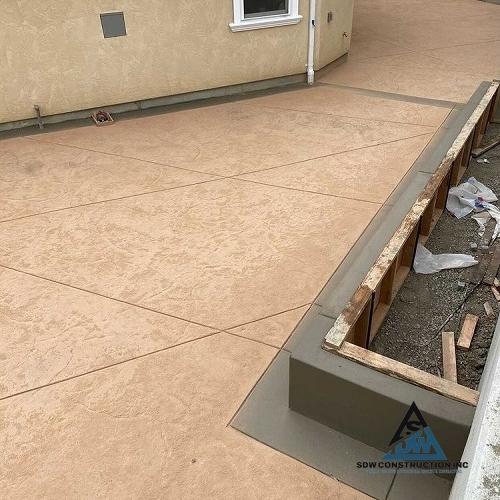
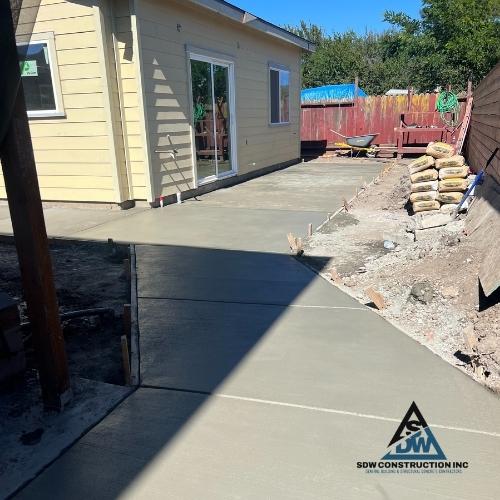
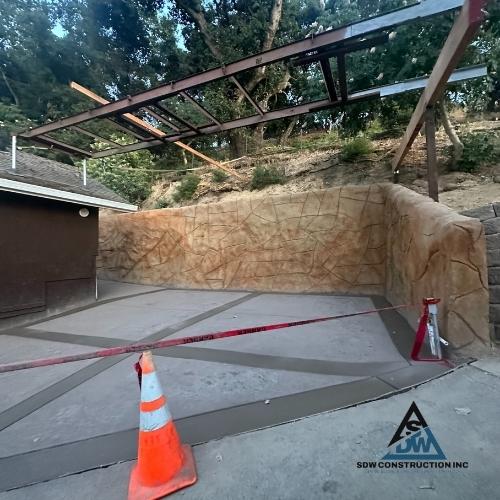
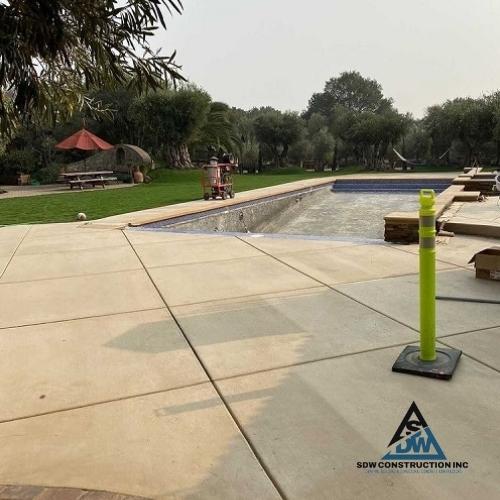
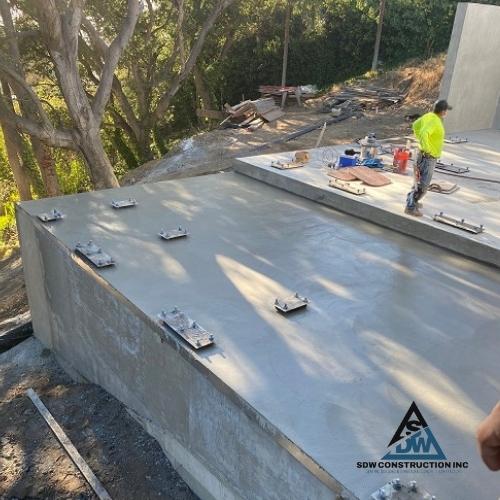
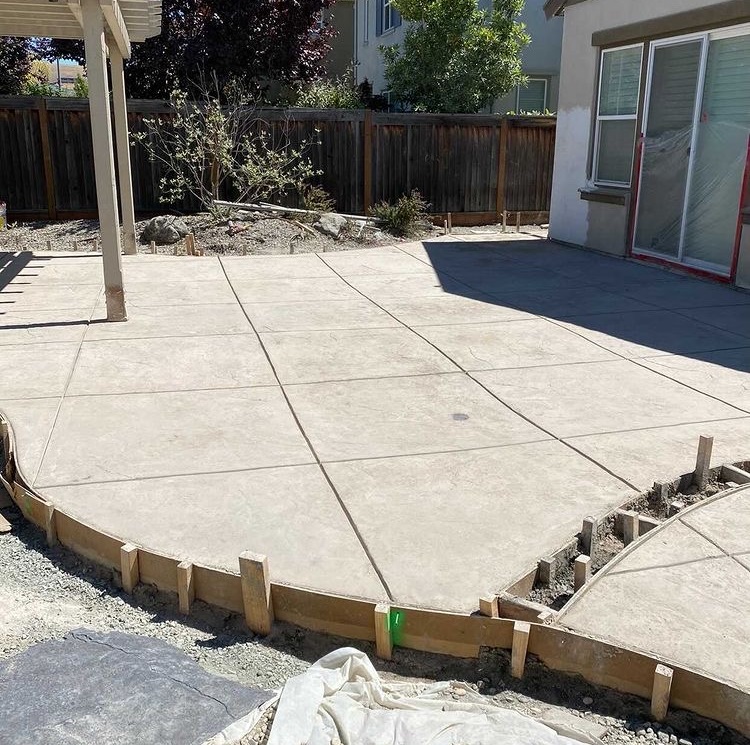
Our recent concrete patio projects across the Bay Area showcase durable craftsmanship, clean finishes, and custom designs built to match each homeowner’s outdoor space. From stamped concrete patios to modern smooth finishes, every project is completed with precision and built to last.
We never rush the prep. Cheap patios crack because contractors skip subbase work and drainage planning. Here’s every step — and why it matters.
Pre-Construction
We visit your property, take measurements, assess soil and drainage conditions, discuss finish options, and confirm permit requirements. You get a detailed written quote — not a ballpark number.
Day 1–2 — Excavation
We excavate typically 6–8 inches to allow for 4 inches of compacted aggregate base and a 4-inch concrete slab. Bay Area expansive clay soils often require extra attention. We remove all organic material, roots, and soft spots.
Day 2 — Base
We lay Class II aggregate base and compact it in lifts to approximately 95% relative compaction — the single biggest factor in whether your patio lasts 5 years or 30.
Day 2–3 — Drainage
Every patio we build drains away from the house — a minimum 1–2% slope. Bay Area patios often require channel drains, French drain tie-ins, or permeable zones to manage seasonal rainfall.
Day 3 — Formwork
We set wood or steel forms to define the patio's shape, establish correct slope, and create any decorative borders or curved edges before the pour.
Day 3–4 — Steel
Residential patios typically use #3 rebar on 18-inch centers. In seismically active Bay Area, we favor rebar for its superior crack control — especially important near fault zones in the East Bay and Marin.
Pour Day
We order ready-mix concrete — typically 4,000 PSI, adjusted to 4,500–5,000 PSI for coastal Bay Area locations. The crew screeds, floats, and applies the chosen finish. Timing and weather matter enormously; we plan around Bay Area fog and temperature carefully.
Pour Day +24 hrs
Control joints are cut to 1/4 of the slab depth to direct where cracks naturally occur. We cure the slab for a minimum of 7 days before any foot traffic is allowed. Full strength is reached at 28 days.
Day 28 — Final
Once fully cured, we apply the appropriate sealer — penetrating silane-siloxane sealers for plain or aggregate finishes, film-forming acrylic sealers for stamped and colored work. We do a final walkthrough and provide your written warranty.
Short answer: yes — and the Bay Area is one of the best markets in the country for outdoor living ROI. Industry cost data for San Francisco suggests homeowners can expect a 60–90% return on investment when installing a quality concrete patio, with premium decorative finishes trending toward the higher end of that range.
Bay Area home buyers prioritize finished outdoor space. A clean, well-built concrete patio directly improves your listing appeal. Premium finishes trend toward the top of the ROI range.
🏡 Year-Round Outdoor Living
Unlike colder US markets, Bay Area patios are functional 10–12 months of the year. That usability is factored directly into how buyers value outdoor spaces here.
What pushes costs higher in the Bay Area? Difficult access (hillside lots, narrow side yards), expansive clay soil requiring extra base prep, demolition of existing concrete ($2–$5/sq ft extra), stamped or decorative finishes (+$6–$14/sq ft), permit fees, and current Bay Area labor rates. All figures are estimates — get a free onsite quote for your exact project.
Concrete can be poured in any shape, finished in dozens of ways, and customized to complement any architectural style — from Victorian San Francisco row houses to mid-century Eichlers in the South Bay.
Flowing curves that follow garden beds or dramatic half-circle entertaining areas. Curved concrete adds visual interest without adding cost.
Ashlar slate stamped patterns are the top request for Bay Area homes. Mimics real flagstone at roughly one-third the cost. Pair with a warm tan integral color.
A contrasting border around a plain slab field transforms an average patio into something custom. Popular in Peninsula and Marin neighborhoods where HOAs restrict dramatic finishes.
Clean straight-line patterns cut into colored concrete after curing create a large-format tile effect at a fraction of tile installation cost. Very popular in Oakland, Berkeley, and San Francisco.
During the pour, we can embed conduit for low-voltage LED path or step lighting. Far cleaner than surface-mount lighting added after the fact.
Concrete slabs can be poured with reinforced pads designed for built-in fire pits, BBQ islands, or outdoor kitchen bases — much more cost-effective than cutting into an existing slab later.
Building a patio in the Bay Area is not the same as building one in Phoenix or the Central Valley. Our specific climate and soil conditions create challenges that contractors from outside the region consistently underestimate.
Large sections of the East Bay sit on expansive Montmorillonite clay soils that swell when wet and shrink when dry. This movement is the leading cause of patio cracking. Our approach: thorough excavation, deeper compacted aggregate base, and closer control joint spacing to accommodate seasonal movement.
The Bay Area receives the majority of its annual rainfall between November and March. A patio without proper drainage will pool water and accelerate concrete degradation. We design every patio with a minimum 1–2% drainage slope and integrate channel drains or perimeter French drains on patios larger than 300 square feet.
Bay Area concrete patios can experience cracking at control joints due to seismic settlement — particularly on hillside lots or properties over fill. We use steel rebar reinforcement on all patio slabs and design slab thickness based on site-specific soil conditions.
Bay Area concrete patios can experience cracking at control joints due to seismic settlement — particularly on hillside lots or properties over fill. We use steel rebar reinforcement on all patio slabs (not just wire mesh), design slab thickness based on site-specific soil conditions, and place control joints thoughtfully to manage any movement without visible damage.
Permit requirements vary meaningfully across Bay Area cities. Always verify with your local building department before any work starts, as requirements change. Here is what our experience shows, city by city.
In SF, most concrete patio installations — including straightforward ground-level slabs — typically require a building permit through DBI. As of January 2024, SF DBI moved to 100% electronic plan review. Permit timelines in SF can range from a few weeks to several months for projects requiring full plan review.
A properly installed concrete patio is genuinely low maintenance — but “low maintenance” still means doing a few things on schedule. Skip sealing and cleaning and a 30-year patio can look tired in 10.
New patios should be sealed no sooner than 28–30 days after the pour. After that, reseal every 3–5 years for plain or aggregate finishes, and every 2–3 years for stamped and colored concrete. Bay Area marine moisture and seasonal rainfall make sealing particularly important.
Before the first significant rains, inspect your patio for any hairline cracks and fill them with a flexible polyurethane crack sealant. Check that drainage channels are clear of debris. Verify the patio still slopes away from the house — soil settlement over time can alter drainage direction.
We’ve been installing Bay Area concrete patios since 2001. Over 20 years of local projects means we understand Bay Area soil, coastal weather, permit requirements, and neighborhood aesthetics better than any out-of-area franchise ever could.
Donec erat rutrum semper nam dui lacinia id ad lorem. Netus consectetur pretium augue habitant nibh montes imperdiet ornare posuere finibus. Sociosqu elementum faucibus porta pede ultricies purus at.
Over 20 years of Bay Area concrete patio work. Licensed, insured, and backed by a written workmanship warranty. Let’s build something you’ll enjoy for decades.
We cover the full range of residential and commercial concrete driveway work across the Bay Area — from new builds to repairs, standard finishes to premium decorative work.

Free onsite visit, site assessment, design consultation, and a detailed written quote. We confirm permit requirements and answer every question before a shovel goes in the ground.

We help you choose the right finish — broom, stamped, exposed aggregate, or colored concrete — and layout to complement your home and work with your drainage and slope.
Our own trained crew handles every step — excavation, base prep, reinforcement, pour, and finishing. We keep you informed throughout and keep the worksite clean and safe.

Final walkthrough with you, project documentation, sealing, and a written workmanship warranty. We don't consider the job done until you're fully satisfied with the result.
Quick answers to questions you may have. Can’t find what you’re looking for? Check out our full documentation.
Bay Area concrete patio costs typically range from $8–$14 per sq ft for a standard broom finish and $12–$20+ per sq ft for stamped or decorative work. Total projects range from roughly $2,000 for a small slab to $32,000+ for a large custom patio.
Bay Area labor, permit, and disposal costs run higher than national averages. Final pricing depends on patio size, site access, existing material demo, soil conditions, finish type, drainage requirements, and permit fees (typically $100–$500 in most Bay Area cities). Always get an onsite quote — phone or photo estimates are rarely accurate for Bay Area conditions.
Physical installation typically takes 3–5 days for most residential patios. You can walk on the slab after 24–48 hours but should avoid heavy furniture for 7 days and full loads for 28 days.
Project timelines also include: permit approval (where required, typically 2–6 weeks in Bay Area cities), scheduling, site prep, curing time, and final sealing. A complete project from estimate to finished patio is typically 4–8 weeks depending on permitting and contractor availability. We give you a realistic schedule upfront — not an optimistic one that gets revised later.
For a standard outdoor dining set and seating area, plan for at least 12×12 feet (144 sq ft). For comfortable entertaining with multiple furniture zones, 16×20 feet (320 sq ft) or larger is recommended.
A general sizing guide for Bay Area patios: 10×10 to 12×12 ft (100–144 sq ft) is functional for a small bistro table and two chairs; 12×16 ft (192 sq ft) accommodates a 6-person dining set; 16×20 ft (320 sq ft) allows both a dining area and lounge seating; 20×24 ft or larger works well for entertaining, outdoor kitchens, or fire pit zones. Bay Area lots — particularly in SF, Berkeley, and Oakland — are often compact, so we frequently design L-shaped or offset patios that maximize usable space within property constraints. During your onsite visit we’ll help you identify the best layout for your specific yard.

We are a licensed and insured Bay Area concrete contractor providing all types of concrete construction for both commercial and residential clients. Operating as SDW Construction / S.D. White Construction, serving the Bay Area since 2001.
630 Second St rodeo CA 94572
Mon–Fri: 7:30AM – 5:30PM
Saturday: Closed
Sunday: Closed
Proudly serving the entire San Francisco Bay Area — San Francisco, Oakland, San Jose, Marin County, the Peninsula, and surrounding cities.
© 2025 SDW Construction / S.D. White Construction. All Rights Reserved.